






Mornings feel softer. Evenings linger a little longer. And suddenly, what touches the skin becomes more noticeable — less forgiving, more present. It is often in these moments that we begin to understand the true benefits of silk fabric, not as luxury alone but as something more considered.

Why breathable fabric matters in warm weather
Warm weather changes the way the body interacts with its environment.
Heat settles differently. Sleep becomes lighter. Fabrics that once felt neutral can begin to feel restrictive, almost disruptive. Breathability, then, is not simply a feature. It becomes a form of support.
A breathable fabric allows air to circulate naturally. It reduces the feeling of heaviness. It creates space between the body and the environment — a subtle but important distinction.
This is where silk begins to reveal its nature.
Not as decoration, but as a material that responds.
Silk is known for its breathable structure. It does not trap heat in the same way synthetic fibres often do. Instead, it allows the body to remain in balance, adjusting quietly without needing attention.
The result is not dramatic.
It is simply easier.
Benefits of silk fabric for warm weather

The question often arises gently: is silk good for warm weather?
The answer is less about suitability, and more about experience.
Silk is naturally temperature regulating. It responds to the body rather than working against it. In warmer conditions, this means it helps release excess heat while maintaining a light, comfortable layer against the skin.
The benefits of silk fabric extend beyond temperature alone.
Its smooth surface reduces friction. There is less resistance, less interruption. Skin feels undisturbed. Hair moves freely. The body is allowed to rest without subtle irritations building over time.
It is also remarkably lightweight.
There is a particular kind of comfort in wearing or resting against something that feels almost absent — and yet, consistently supportive.
In warmer weather, this becomes more than a preference. It becomes a quiet standard.
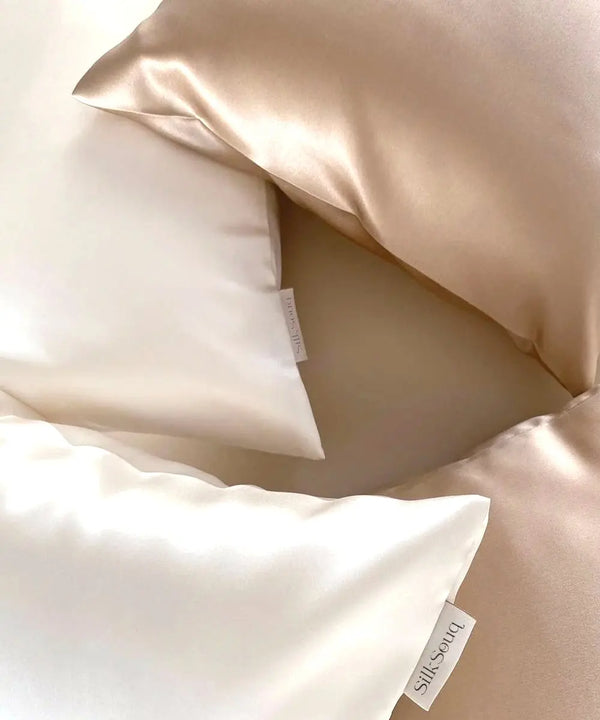
Within sleep environments, this difference is often felt most clearly. A silk pillowcase, for instance, does not hold onto warmth in the same way heavier fabrics might. It remains cool to the touch, even as the night deepens.
A small change, perhaps.
But one that repeats itself, night after night.
Silk vs cotton: a subtle but noticeable difference

Cotton is familiar. Reliable. Widely used.
But familiarity does not always mean equivalence.
When comparing silk vs cotton, the difference is often felt in texture first.
Cotton has a more matte, structured surface. It can feel slightly heavier, especially in warmer conditions. It absorbs moisture, but does not always release heat as efficiently.
Silk, by contrast, is smoother. More fluid.
It allows for movement — both of air and of the body itself.
This creates a different kind of experience. One that feels less like managing comfort, and more like being supported by it.
There is also a visual element.
Silk carries a quiet luminosity. It reflects light softly, contributing to an environment that feels lighter, more considered. Even this, in subtle ways, can influence how a space feels in warmer months.
After experiencing this difference, many find it difficult to return to heavier alternatives.
Not because they are inadequate.
But because a new standard has been set.
Spring as a shift toward lighter environments

Seasonal change often invites reflection.
Not dramatic transformation, but small adjustments. A lighter layer. A different fabric. A shift in how we approach comfort.
Spring, in particular, brings with it a sense of release.
Spaces become more open. Materials become more important. What once felt acceptable begins to feel slightly misaligned.
This is where silk integrates naturally.
In daily layers, a silk camisole offers breathable comfort without weight. It becomes part of the rhythm of dressing — not an addition, but a refinement.
In sleep environments, small upgrades begin to matter more. The surface of a pillow. The way fabric meets the skin. These details, often overlooked, begin to shape the quality of rest.
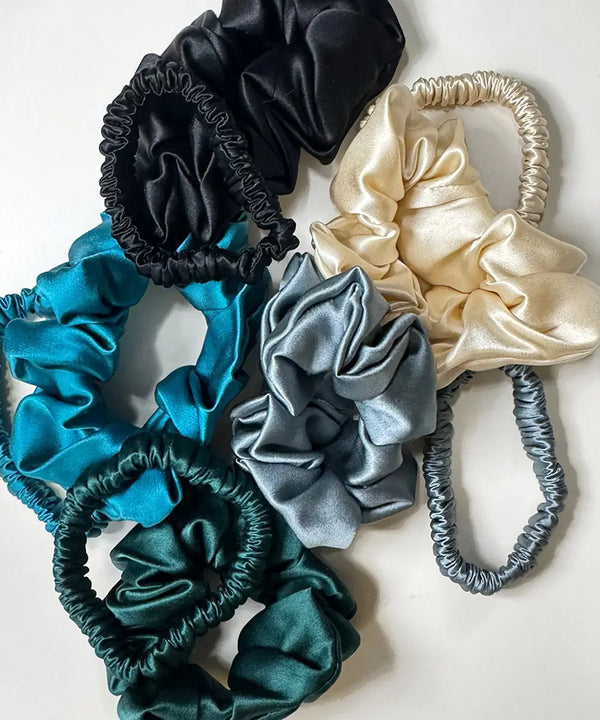
Even in accessories, the idea of reduced friction becomes relevant. Silk moves with you. It does not pull or resist. It allows the day to unfold with less interruption.
These are not changes that demand attention.
They are changes that quietly improve how things feel.
Closing
Not all comfort is immediate.
Some forms reveal themselves slowly — through repetition, through experience, through the absence of discomfort rather than the presence of something new.
The benefits of silk fabric belong to this category.
They are not loud. They do not ask to be noticed.
But over time, they shape the way daily life feels.
And once felt, they are rarely forgotten.


Leave a comment
All comments are moderated before being published.
This site is protected by hCaptcha and the hCaptcha Privacy Policy and Terms of Service apply.