





The Edit · October 2026
The anatomy of a silk pillowcase
Every part of it is a decision. Here is what each one was for.

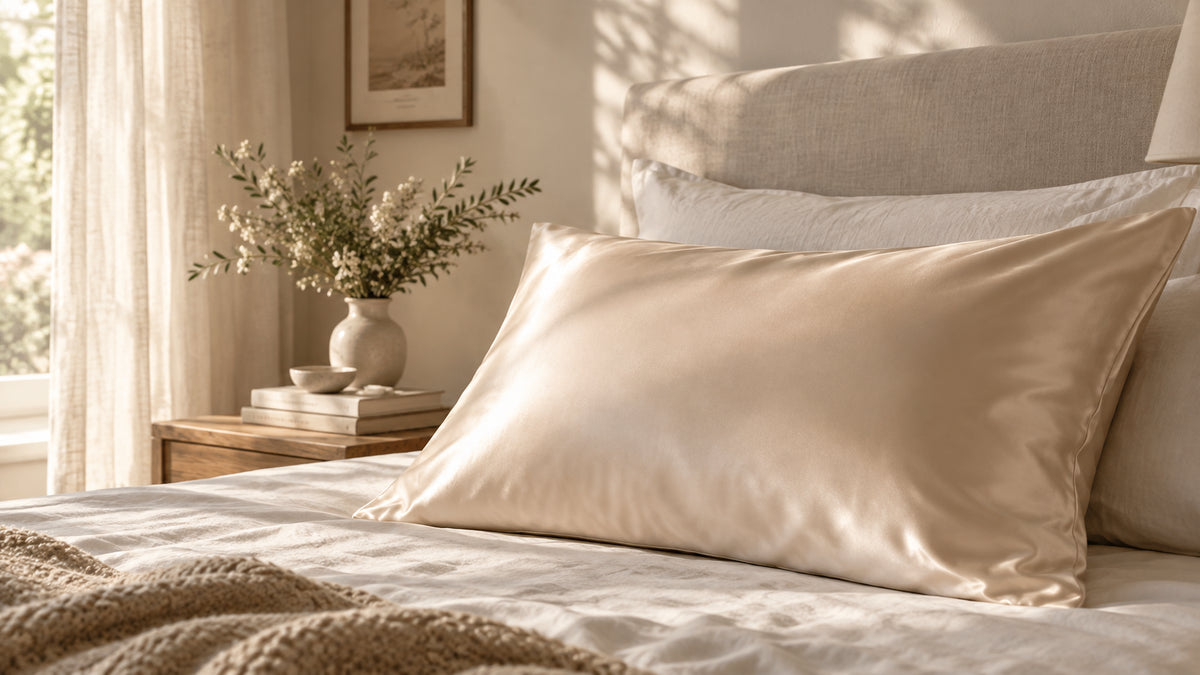
A silk pillowcase looks like a simple object. A rectangle of fabric, an opening, a seam. It is not simple. Each element in it was chosen, and each choice has a consequence that only shows up at two in the morning, or on the fortieth wash, or when a pillow that was nearly the right size turns out not to be. What follows is the object taken apart, piece by piece, so that the specification on the label reads as a set of reasons rather than a set of numbers.
Start with the fibre, because everything else is built on it.
The fibre, the weight and the weave of a silk pillowcase
Grade is the first decision. Mulberry silk is sorted by the length and uniformity of its filaments, and 6A is the top of the scale: the longest, most even threads, with the fewest breaks and slubs. The reason it matters is the surface. A filament that runs unbroken through the weave gives a face that is uniformly smooth. A lower grade gives one that is smooth in most places. The face does not know which places those are.
Momme is the second, and it is the most misread. It is a weight, not a score. Nineteen momme is right for a scarf that has to move. Twenty-two is right for a pillowcase that has to hold its surface over hundreds of nights and dozens of washes without thinning. Heavier is not better in itself. Heavier is correct where the object will be leaned on, and the Signature range sits at 22 momme because a pillowcase is leaned on every night.
Then the weave. Charmeuse is satin-faced, which means the long floats of thread that give silk its lustre are arranged on one side. That side faces the skin. The decision is not about how the pillowcase looks on the bed. It is about which surface the cheek and the hair actually meet.
Heavier is not better in itself. Heavier is correct where the object will be leaned on.
The closure, the seam and the cut
The closure is a hidden envelope rather than a zip. A zip is faster to make and easier to photograph. It is also a line of hard teeth and a metal pull inside a thing designed for the face, and hair finds it. The envelope keeps the pillow in and keeps everything hard out.
The seam is French-finished. The raw edge is folded and enclosed inside a second line of stitching so that nothing frays from the inside out in the wash. It is invisible when the pillowcase is new. It is the reason the pillowcase is still intact when it is not.
And the cut. A pillowcase is made to the pillow, not approximately near it. Slack fabric is where friction lives: a case that is too large shifts under the head and rubs; one that is too small pulls the seam and stretches the weave thin. Fifty-one by seventy-six for a Queen, because that is what a Queen pillow is.
Which brings the argument to its worked example. A King pillow is larger, carries more surface and takes more turning. It does not ask for a Queen case stretched to fit, and it does not ask for 22 momme asked to do more than it was weighed for. The King Size Pillowcase answers with 25 momme, cut to 51 by 91 centimetres, in two colourways. Arriving. Stated once, because by now the reasoning is already hers.
The Signature range

Signature Silk Pillowcases
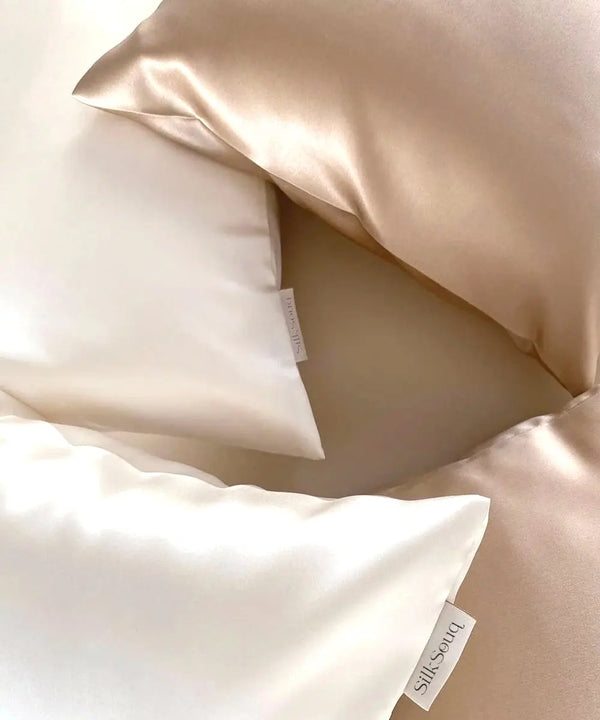
22 momme. Grade 6A. OEKO-TEX certified mulberry silk, FSC-certified packaging, a 5.0 Google rating. Every part of it a decision, and every decision explained above.
View the rangeSilkSouq
silksouq.com


Leave a comment
This site is protected by hCaptcha and the hCaptcha Privacy Policy and Terms of Service apply.